Enabling Massive Biomechanical Sims
A finite-element software pipeline that let biomechanics researchers simulate the proximal femur at a resolution that had previously needed supercomputers.
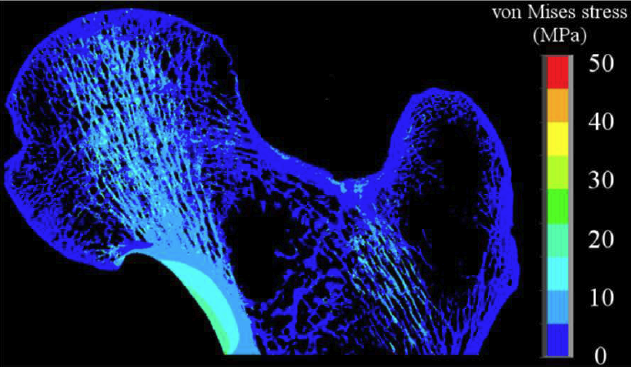
The trabecular and cortical compartments of the proximal femur share the load in ways that matter clinically: if you want a better hip implant, you need to know how the bone around it actually carries force. Micro-structural finite element analysis gets you that answer, but conventional models of a whole femur at that resolution were supercomputer work — large, bespoke, and usually simplified with a single point load at the hip that produces numerical artefacts right where the interesting stress lives.
I built the software pipeline that removed the bottleneck. Written in C++, it generates micro-structural finite element models of the femur from CT data, applies a realistic hip pressure distribution over the femoral head instead of a point load, solves the elastic problem, and then post-processes a result file large enough that most tools fall over. The researchers could simulate at resolutions they had not reached before, and the accuracy of the stress fields improved with it.
A new finite-element software pipeline for the micro-structural analysis of the proximal femur
S. Martelli, E. Perilli, G.S. Ruthenbeck, Y. Bala, M. Taylor, K.J. Reynolds.
The work was presented at CMBE15, the 4th International Conference on Computational & Mathematical Biomedical Engineering, at the Ecole Normale Superieure de Cachan, 29 June – 1 July 2015.